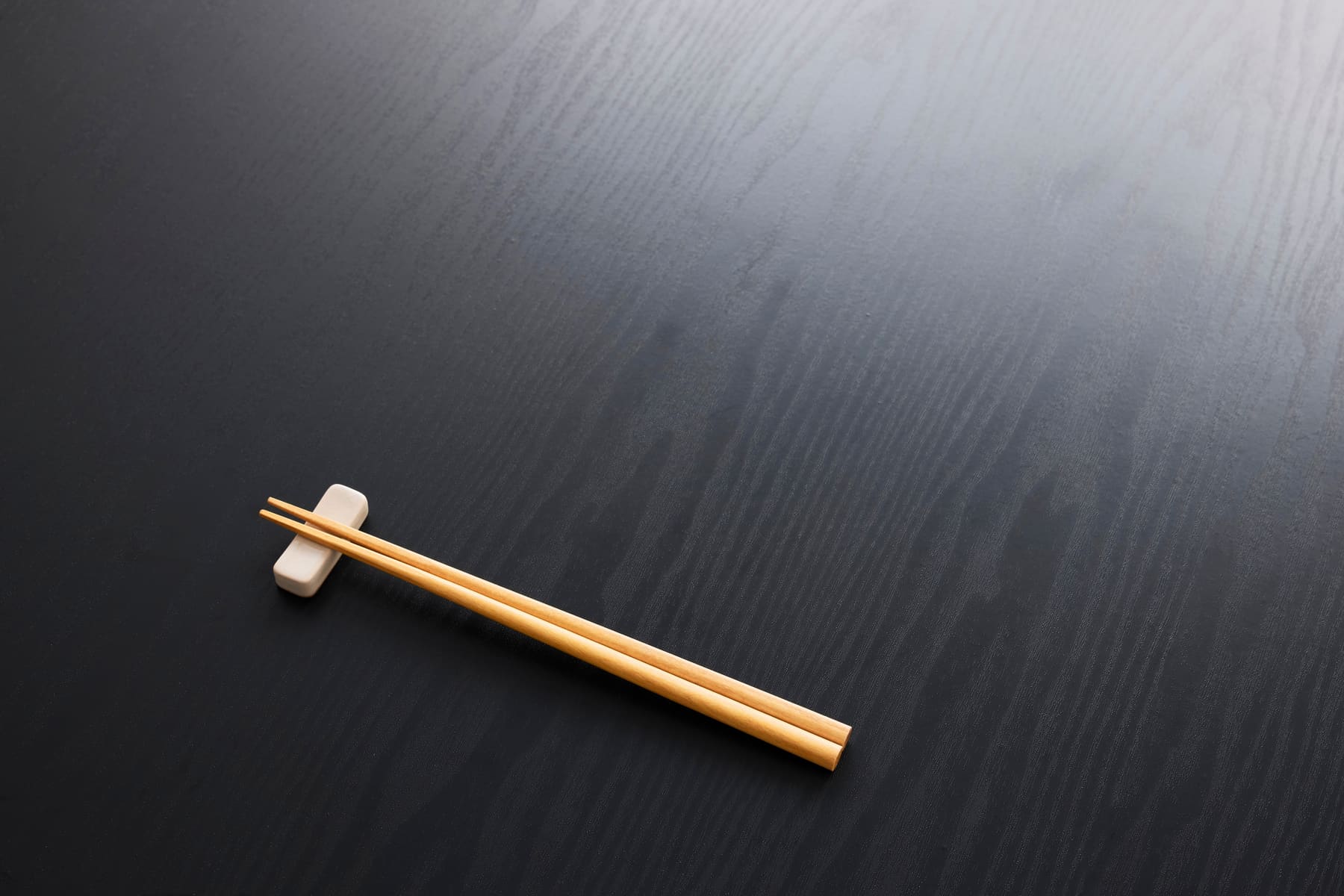
Japanese dining etiquette is easier than its reputation. Nobody expects a first-time visitor to know every rule, and a mistake made in good faith is rarely a problem. A handful of chopstick rules and everyday customs cover most meals, and a few more things matter at the small counter restaurants where the cooking happens in front of you. This guide covers both.
Japanese eating etiquette: chopsticks
Two chopstick rules matter more than the rest, because both are linked to funerals. Do not stand your chopsticks upright in a bowl of rice: it recalls the bowl of rice, with chopsticks standing in it, that is offered to someone who has died. And do not pass food from your chopsticks to someone else's: after a cremation, family members pick up the bones together with chopsticks, so passing food this way recalls a funeral. To share food, put it on the other person's plate, or on a small plate they can take it from.
The other rules are about tidiness. When you are not using your chopsticks, put them on the chopstick rest if there is one, not across the top of your bowl. Japan's Ministry of Agriculture, Forestry and Fisheries lists the other habits to avoid: pointing at people or things with them, hovering over the dishes while you decide, starting to take one food and then switching to another, and pulling a dish towards you with them. If you are taking food from a shared dish, look for serving chopsticks, or ask for a small plate.
Disposable wooden chopsticks come joined at the top; pull them apart and put them down. GO TOKYO, the city's official travel guide, advises against rubbing them together, which it says is seen as an insult to the restaurant. If you cannot manage chopsticks, it does no harm to ask for a spoon or fork.
Japanese eating culture: everyday customs
Before eating, many Japanese people say itadakimasu, roughly "I humbly receive", and after the meal, gochisousama deshita, "thank you for the meal". You do not have to say them, but the second one, said to the staff as you leave, is a good way to show you enjoyed it.
Many restaurants give you a small wet towel, called an oshibori, when you sit down. It is for your hands.
Slurping noodles is normal and accepted, at a ramen counter or a soba shop. Small bowls of rice or soup are meant to be lifted and held while you eat, and you drink miso soup straight from the bowl. Pour only a little soy sauce into the small dish, and dip sushi fish-side down rather than soaking the rice.
At Tsukiji Outer Market, visitors are asked not to eat while walking; eat at the shop or in a designated area. Finishing everything on your plate, down to the last grains of rice, is considered polite, and restaurants generally do not let you take leftovers home, so order what you can eat. If you have a small appetite, it is polite to tell the staff in advance so they can adjust the portion. In a group, you are usually expected to order at least one item each, and you cannot bring in food or drink from outside.
At a counter restaurant
At some kaiseki and sushi counters, everyone starts at the same time, and the courses are timed for the whole counter. Arriving fifteen minutes late does not just inconvenience you; it can put the kitchen's timing out for the whole room. If you are going to be late, call ahead. If you are going to be very late, expect that the restaurant may not be able to seat you at all.
GO TOKYO's sushi guide advises going easy on cologne and perfume, because sushi has delicate flavours. At a counter you sit close to the fish and to other guests, often in a small room. Save the perfume and the scented hand cream for afterwards.
Photography is usually fine, briefly, before you eat; it is usually not fine over someone else's shoulder, with a flash, or held up for so long that the dish goes cold. If you are unsure, watch what the regulars around you do, or simply ask.
Allergies, dietary needs and tipping
Disclose dietary restrictions when you book, not when you sit down. A kitchen that builds a course around a shellfish allergy needs to know before it buys the fish, not after. Telling the chef at the counter that you cannot eat something the whole menu is built around puts them in a position they cannot get out of gracefully, and often means you eat worse than you would have if you had said something when you booked.
Tipping is not customary in Japanese restaurants, and the Tokyo Convention & Visitors Bureau's manners handbook says a tip will almost certainly be refused. Say thank you, mean it, and let the bill be the bill. Our guide to tipping in Japan explains what to do instead.
Sources
- Ministry of Agriculture, Forestry and Fisheries: Chopstick manners to avoid (kirai-bashi) (Japanese)
- Ministry of Agriculture, Forestry and Fisheries: aff magazine, May 2016, chopsticks and how to eat soup and sushi (Japanese)
- GO TOKYO Gourmet: Learning Japanese dining etiquette in Tokyo (18 December 2025)
- Tokyo Convention & Visitors Bureau: How to Enjoy Tokyo! Manners and customs handbook, English edition (September 2025, PDF)
- GO TOKYO: Tokyo local food (tips on chopsticks)
- GO TOKYO: Sushi in Tokyo (eating at Tsukiji Outer Market, soy sauce)
- nippon.com: Chopstick customs and why some are taboo (Japanese)
Figures checked against the sources above on 12 November 2026.
Continue from here