Cuisine
Sushi in Tokyo
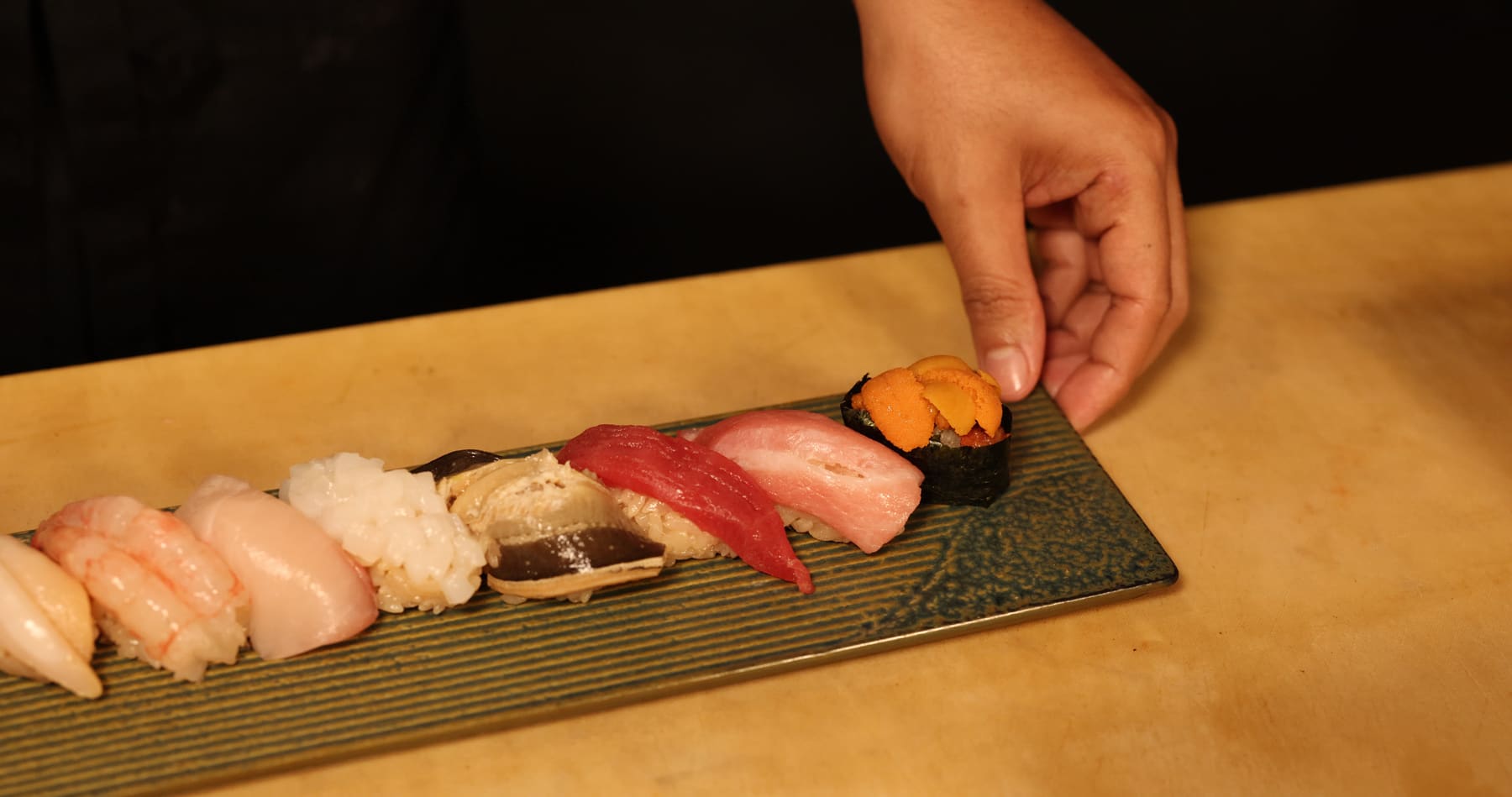
Tokyo is generally credited as the place where nigiri sushi took its present form: a hand-pressed piece of seasoned rice with fish on top, first sold from street stalls when the city was still called Edo. The city still covers the whole range, from conveyor belts where you pick up plates as they pass to small counters where the chef decides every piece.
Types of sushi restaurant
Conveyor-belt shops, called kaiten-zushi, are among the cheapest and the easiest to walk into. Plates go past on a belt or arrive from a touch-screen order, and the bill is counted from the plates you have taken. Standing sushi bars, where you eat at a counter without a seat, are quick and inexpensive too, and many are near stations.
The neighbourhood sushi shop sits in the middle: a counter and a few tables, a menu on the wall, and set meals at lunch. At the top are omakase counters, often with fewer than ten seats, where the chef serves a fixed course piece by piece. Price does not sort them cleanly. What changes as you go up is how much the chef does before the fish reaches you, such as curing, ageing or marinating, and how far ahead you need to book. In September 2026, a standard ("nami") serving of nigiri sushi at a restaurant in Tokyo's 23 wards averaged ¥1,876 including tax, according to Japan's Retail Price Survey. That is an average for an ordinary serving, not a guide to the price of an omakase course.
A few words cover most menus. Nigiri is the pressed piece of rice and fish. Maki is a roll wrapped in nori, and temaki is a cone-shaped hand roll. Gunkan is a band of nori around rice holding something loose, such as salmon roe or sea urchin. Sashimi is fish without rice, and chirashi is a bowl of rice with fish scattered on top.
How to order
At a counter you can order a few pieces at a time, ask for omakase and let the chef choose, or take a set, which is usually listed by price level. At a conveyor-belt shop the touch screen does the work, and the large chains have an English setting. Many shops start with a cup of green tea; at conveyor-belt shops there is usually a hot-water tap at your seat for making your own.
At most counters, the chef has already put wasabi between the fish and the rice, and many brush on soy sauce or another seasoning before serving. If a piece arrives glossy, eat it as it is. When you do use soy sauce, dip the fish side, not the rice, which falls apart. Nigiri can be eaten with chopsticks or with your fingers, ideally in one bite. The pickled ginger, gari, is for clearing your palate between pieces.
Omakase counters have a few customs of their own. Arrive on time, because every guest is served the course together. Avoid strong perfume, which competes with the fish. Ask before taking photographs, and eat each piece soon after it is set down, because the chef has timed it to be eaten then.
Booking
Conveyor-belt shops and most neighbourhood counters do not need a booking, though the busy chains have numbered tickets or an app for joining the queue. Omakase counters are the opposite: most work by reservation only, and the well-known ones fill weeks ahead. Many take bookings through online reservation services, and some only through a hotel concierge or a phone call in Japanese.
Read the cancellation terms before you book. Small counters buy fish for the exact number of guests, so many charge the full course price for a late cancellation or a no-show. If you have an allergy or there is something you do not eat, say so when you book rather than when you sit down.
When to go
Lunch is the usual way to try a serious sushi counter for less. Many shops serve a shorter set or a smaller course at midday, and the same chef makes it. Weekday lunch is also when office workers fill the neighbourhood shops, so arrive at opening time or after the main rush.
Conveyor-belt chains are busiest on weekend evenings and around family meal times, when the queue for a table can be long. Many sushi shops close one day a week, and some close between lunch and dinner, so check a shop's hours before you travel to it.
Where to go
Ginza is known for its concentration of high-end sushi counters, many of them in small buildings on side streets. The Tsukiji Outer Market, the shops and stalls that stayed when Tokyo's wholesale fish market moved to Toyosu in 2018, has sushi restaurants that open early in the morning. Toyosu Market has restaurants of its own inside the market buildings.
Conveyor-belt chains and standing sushi bars are everywhere, especially around big stations and in shopping centres. As with most food in Tokyo, the sushi nearest to you is often good enough, and an expensive counter is something to book ahead for a particular meal.
Allergies and vegetarian sushi
Raw fish is only part of sushi. Many shops also serve cooked or cured pieces, such as grilled eel, simmered conger eel, boiled prawn and rolled omelette. If you do not want raw fish, ask for cooked pieces; most counters can make a selection. Shellfish allergies are worth stating clearly, because shellfish can appear in sauces and stock as well as on top of the rice.
Vegetarian sushi is possible but limited. Cucumber rolls (kappa maki), pickled radish rolls and rolls of simmered gourd (kanpyo) are common, but the rolled omelette is often made with fish stock, and some seasonings contain fish. A written card in Japanese is the most reliable way to explain what you do not eat.
Sources
- Retail Price Survey, Statistics Bureau of Japan (e-Stat table 0003421913, item 2121 nigiri sushi), September 2026 (Japanese)
- Statistics Bureau of Japan: items and standard specifications, September 2026 survey (Excel, Japanese)
- Statistics Bureau of Japan: prices in the Retail Price Survey include tax (Japanese)
Figures checked against the sources above on 12 November 2026.
We are still choosing the restaurants for this page. Until they are here, our guides cover how to book and what to expect.